The Question of Protein
How much protein should we be eating? I am surrounded by friends and family sprinkling protein powder onto their protein shakes. The societal obsession with protein and muscle growth can be traced largely to Peter Attia, who in turn was influenced by Don Layman, a scientist with financial relationships with the National Cattlemen’s Beef Association and the National Dairy Council (AKA Big Meat) and who touts the more complete amino acid makeup of animal protein. Even my wife has joined the anabolic stampede, drawn in her case by the promise of early satiety and weight loss. Even I, in a prior version of this post, had jumped on the protein bandwagon.
Yet there are considered opinions from the longevity community pumping the breaks on the protein hysteria. Dudley Lamming published a long review in Cell Press Blue that gathers the entire animal literature on protein and amino acid restriction into a single framework and it changed my mind about several things I had previously thought and written about, so I’ve incorporated this framework in this post. I end with an explicit accounting of how much we actually know and how certain we can be about making recommendations about protein. Spoiler: moderate certainty.
Overall Spoiler: It’s not about protein, you really want to restrict the handful of amino acids most commonly found in meat. So plant protein is protective, animal protein (including whey protein) may accelerate aging.
Hyperfunction
Let’s start with the framework that Mikhail Blagosklonny called hyperfunction theory. Blagosklonny was an independently wealthy Russian scientist who moved to the United States and had standing and stature in the society of longevity science. His primary claim was that the growth programs that build you during development do not switch off once you reach adulthood. They keep running. And many of the diseases of aging (atherosclerosis, hypertension, hyperinsulinemia, the proliferative cancers) are what continued growth looks like in a body that no longer needs to grow. The same anabolic axis that builds tissue in a child and repairs muscle in an athlete is, when chronically engaged in midlife, the axis that underwrites a measurable share of cancer and metabolic disease. (Blagosklonny himself took heroic doses of rapamycin for years and died of brain cancer; people said “thank goodness he was on rapamycin” rather than asking the obvious question of whether he caused his own disease by beating down his immune surveillance). The hyperfunction theory is relevant here because protein fuels growth. Could it be that our protein feeding frenzy is driving hyperfunction and is paradoxically a life-shortening intervention? The rest of this post is an attempt to answer that question.
The initial players: GH / IGF-1 / mTORC1
The lever under all of this is the growth-hormone / IGF-1 / insulin / mTORC1 axis—the primordial circuitry that decides whether a cell grows and divides or preserves and repairs itself. This is the system that operates in all forms of life and is a way that the organism aligns with environmental conditions of nutritional availability or scarcity. Valter Longo and Morgan Levine proposed that in midlife, sustained anabolic drive (high IGF-1, tonically activated mTORC1) promotes proliferation in cells that are already accumulating mutations.
Leucine, one of the branched-chain amino acids (BCAA’s), is the most potent dietary activator of mTORC1 we know. In 2009 Christopher Newgard’s group ran targeted metabolomics on lean versus obese subjects and found that the signature most strongly tracking insulin resistance was not fat or carbohydrate but the BCAA’s: leucine, valine, isoleucine. Feeding rats a high-fat diet supplemented with BCAA’s reproduced the insulin resistance of high-fat feeding alone, despite less food and less weight gain. Animal protein is rich in BCAA’s; chronic excess in a body that is already insulin-resistant keeps mTORC1 switched on. By this logic, animal protein is a longevity liability.
The strongest evidence that the GH/IGF1 axis matters: knocking it out is a life-extension intervention.
If growth signaling really drives the diseases of aging, then disabling it should be protective. And it is. GH-receptor-knockout mice share dysfunctional GH/IGF-1 signaling and live 30–60% longer than wild-type mice, with delayed tumors. The human counterpart is Laron syndrome (growth-hormone receptor deficiency), in which circulating IGF-1 is profoundly suppressed. In a cohort of 99 affected subjects in southern Ecuador followed by Walter Longo for over two decades, there was one non-lethal cancer and zero cases of diabetes. Among matched relatives in the same villages eating the same food, cancer ran about 17% and diabetes about 5%. Strikingly, the Laron subjects are often more obese than their relatives. A population that is obese yet nearly cancer- and diabetes-free tells you that adiposity per se is not the connection between metabolic state and cancer. The connection is IGF signaling.
The dose-response is visible in ordinary people too. In the UK Biobank (n ≈ 412,645), each 5-nmol/L increment in circulating IGF-1 was associated with higher risk of breast, prostate, colorectal, melanoma, kidney, and thyroid cancers—though this is complicated because lung, ovarian, head-and-neck, and liver cancers ran the other way, a reminder that IGF-1 is not a uniform poison. In EPIC-Heidelberg, higher IGF-1 was associated with breast and prostate cancer, and the relationship between IGF-1 and all-cause mortality was U-shaped: both the lowest and the highest quintiles carried excess hazard. Very low IGF-1 carries the costs of frailty and cardiovascular fragility; persistently high IGF-1 in midlife appears to drive the diseases of adulthood. The optimum sits in the middle and most likely drifts upward with age.
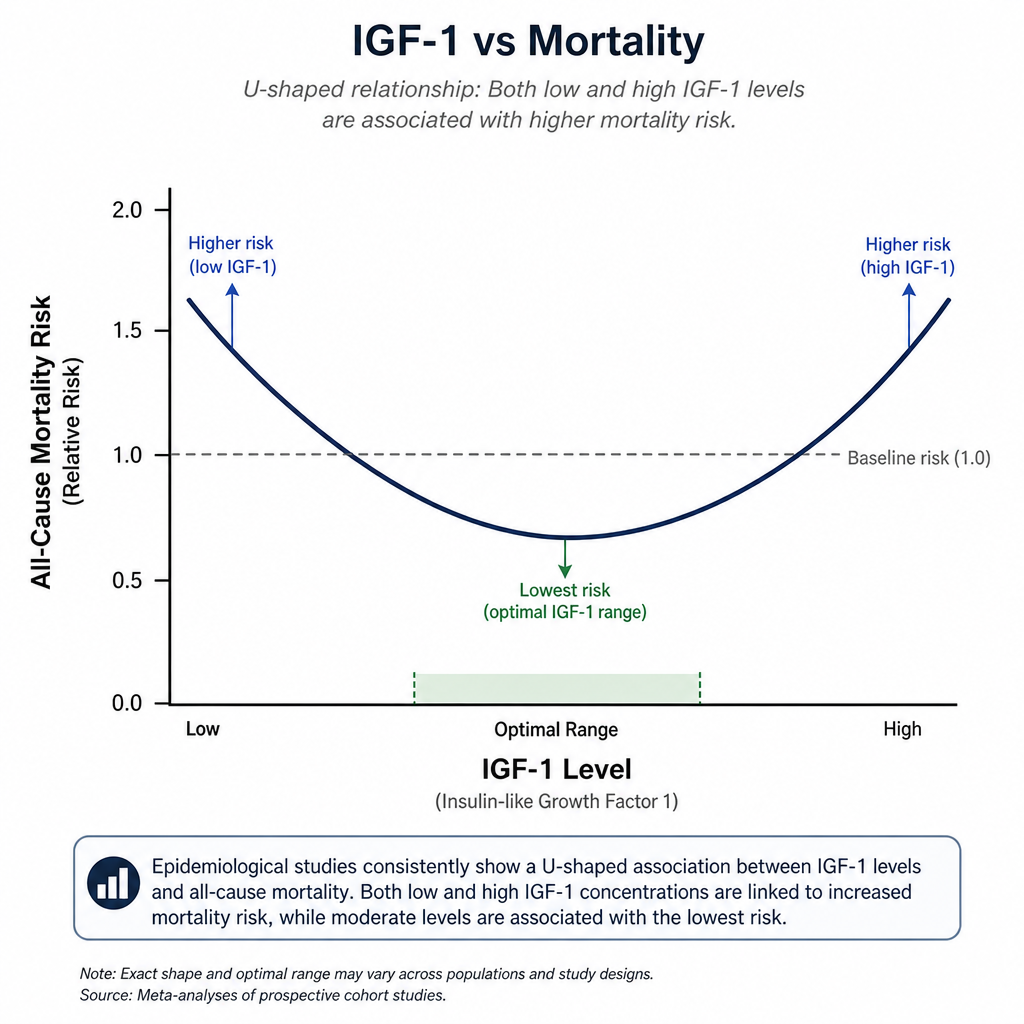
So by this logic, the goal is not to reduce growth signaling as much as possible but rather to hit a sweet spot that ends up being a moving target.
Back to Protein: the difference between plant and animal protein
Levine and Longo went on to do an analysis of NHANES III, retrospective data covering 6,381 American adults aged 50 and over (1). Among 50–65 year-olds, high animal protein intake was associated with a 75% increase in all-cause mortality and a roughly four-fold increase in cancer mortality over 18 years; plant protein carried no such signal. But after age 65 the direction flipped: high protein was associated with lower all-cause and cancer mortality. Longo suggested that with age, IGF-1 falls as growth-hormone secretion declines (somatopause) and anabolic resistance sets in, so that sarcopenia and frailty become the life-limiting risks. Prior to that, it’s growth and proliferation that is the risk. The same signal that is dangerous early becomes protective late. We should mention that NHANES is a frequently vilified single cohort built on one 24-hour dietary recall, with modest numbers and wide confidence intervals in the relevant strata, and it has never been cleanly replicated. It is the single piece of evidence for an age-dependent flip, and it deserves skepticism.
The Harvard Nurses’ Health Study and Health Professionals Follow-up Study is a better study and presents stronger data. 131,342 participants, up to 32 years of follow-up, repeated diet assessments. Each 10% of calories from animal protein was associated with about 2% higher all-cause and 8% higher cardiovascular mortality; each 3% from plant protein with about 10% lower mortality; and substituting plant for animal protein (especially processed red meat) with substantially lower mortality. Critically, the animal-protein signal was concentrated in people who already had another risk factor—smoking, heavy drinking, obesity, inactivity. In otherwise healthy people it was weak.
So there seems to be some benefit associated with plant protein and potentially some drawbacks of animal protein.
The complication: total protein is not the villain
If you stop at Levine and Harvard, you conclude that protein shortens life. But that conclusion is complicated by the wider human literature. A 2020 systematic review and dose-response meta-analysis in the BMJ pooled 31 prospective cohorts and roughly 715,000 participants with up to 32 years of follow-up. Higher total protein intake was associated with lower all-cause mortality, not higher. There was a difference between plant and animal protein: plant protein was associated with lower all-cause and cardiovascular mortality. Animal protein, taken on its own across these cohorts, was not significantly associated with cardiovascular or cancer mortality.
So the human observational signal is that plant protein is better than animal protein, and that total protein is, if anything, protective. Recall that in the Harvard nurses study, the animal-protein harm clustered in people with other risk factors. Read together, these say that much of what looks like a protein effect may be the effect of the foods animal protein arrives in and the company those foods keep: processed meat, low fiber, the rest of an unhealthy pattern.
It is also worth correcting any assumption that less protein is automatically safer. Studies using the indicator amino acid oxidation method estimate average protein requirements above the current RDA of 0.8 g/kg/day in both younger and older adults. Low muscle mass and low strength are themselves robust predictors of mortality across all of adulthood, which is why geriatric consensus bodies such as PROT-AGE and ESPEN recommend 1.0–1.2 g/kg/day or more for older people, in some cases 1.6 g/kg.
The new evidence: protein restriction as its own intervention
Knopf and Lamming labs found that protein restriction in model organisms increases lifespan (10). Across the studies they tabulate (trout, rats, flies, and several mouse strains) lowering dietary protein extends life by anywhere from single digits to more than 50%, including roughly 35% in male mice dropped from 21% to 7% protein, and about 19% even in a progeroid (Ercc1-deficient) mouse. This is one of the more reproducible findings in experimental gerontology, though admittedly in animal models.
The centerpiece here is not IGF-1. Here we introduce a new player: FGF21, a hormone induced by nutritional stress. Protein restriction raises FGF21 in mice, rats, and humans. Mice lacking FGF21 get no lifespan benefit from protein restriction at all, and mice engineered to overexpress it live roughly 30–40% longer. FGF21 drives energy expenditure through browning of white fat, improves lipid handling, and suppresses senescence in fat and liver. Interestingly, Apollo Pharma has a promising GLP/FGF21 agonist in phase 2. Alongside FGF21 sit two nutrient sensors: GCN2, which detects amino acid scarcity and triggers a coordinated stress and autophagy response, and mTORC1, whose inhibition appears to be necessary for the benefits of protein restriction to appear at all.
If IGF-1 is only one channel among several, and the FGF21/GCN2/mTORC1 route is the dominant one, then dietary protein can matter a great deal for aging even though it may not have a profound effect on IGF-1. A weak IGF-1 response is an argument against IGF-1 as the mediator. It is not an argument against protein as a lever.
Human testing of protein restriction
There are human trials of protein restriction. Several of them are randomized, they are short but they are encouraging.
- A 43-day low-protein diet lowered body weight, fat mass, and fasting glucose despite participants eating morecalories. A five-week protein-restriction study in lean men improved insulin sensitivity and raised energy expenditure.
- Twenty-seven days of protein restriction in people with metabolic syndrome reduced adiposity, improved insulin sensitivity, and lowered glucose, lipids, and inflammation.
- Restricting BCAAs by about 75% for a week halved circulating BCAAs and improved insulin sensitivity.
- A four-week trial cutting them by about 60% improved glucose and insulin homeostasis, raised FGF21, and measurably reduced mTORC1 signaling in fat tissue.
- Eight weeks of sulfur amino acid restriction raised FGF21 and reduced body weight.
- In the other direction, a high-protein low-carbohydrate diet was recently found less effective than a moderate-protein diet at improving glucose tolerance and driving prediabetes remission.
None of these studies measures what we care most about which is lifespan, but only because it’s not possible to study lifespan in humans. All longevity research in humans focuses on surrogate markers.
It’s not protein per se, it’s a few amino acids.
The most useful thing in the Lamming review is that restricting the essential amino acids reproduces the benefits of protein restriction in flies and mice; restricting the non-essential ones does not. Within the essentials, three carry most of the weight.
- METHIONINE: Restriction extends rodent lifespan across many studies, in the range of roughly 7% to 42%, improves mitochondrial function and lipid metabolism, and reduces frailty even when started late in life. It works partly through FGF21 and partly through mTORC1 inhibition. Notably, the benefit generally requires restricting cysteine as well, since cysteine is made from methionine.
- ISOLEUCINE: This is the surprise of the last few years. Restricting isoleucine alone extended the lifespan of genetically heterogeneous male mice by about a third, reduced frailty, and shifted the molecular profile of aged animals toward a younger state—and it worked when begun in already-old mice. Higher circulating isoleucine in humans tracks with higher mortality risk and with BMI.
- VALINE: Restriction alone extended male mouse lifespan by about 23%, improved metabolic health, and reduced hepatic senescence.
Although LEUCINE is the most potent mTORC1 activator we know and is the amino acid the supplement industry sells to build muscle, it appears not to matter for lifespan in animal models. Leucine supplementation does not extend the lifespan of mice. Leucine restriction produces contradictory results across labs, including one finding that restricting it made mice fatter. In humans, leucine supplementation reliably raises muscle protein synthesis but does not reliably improve muscle function. The Lamming review’s conclusion is that leucine restriction is unlikely to be responsible for the benefits of a low-protein diet.
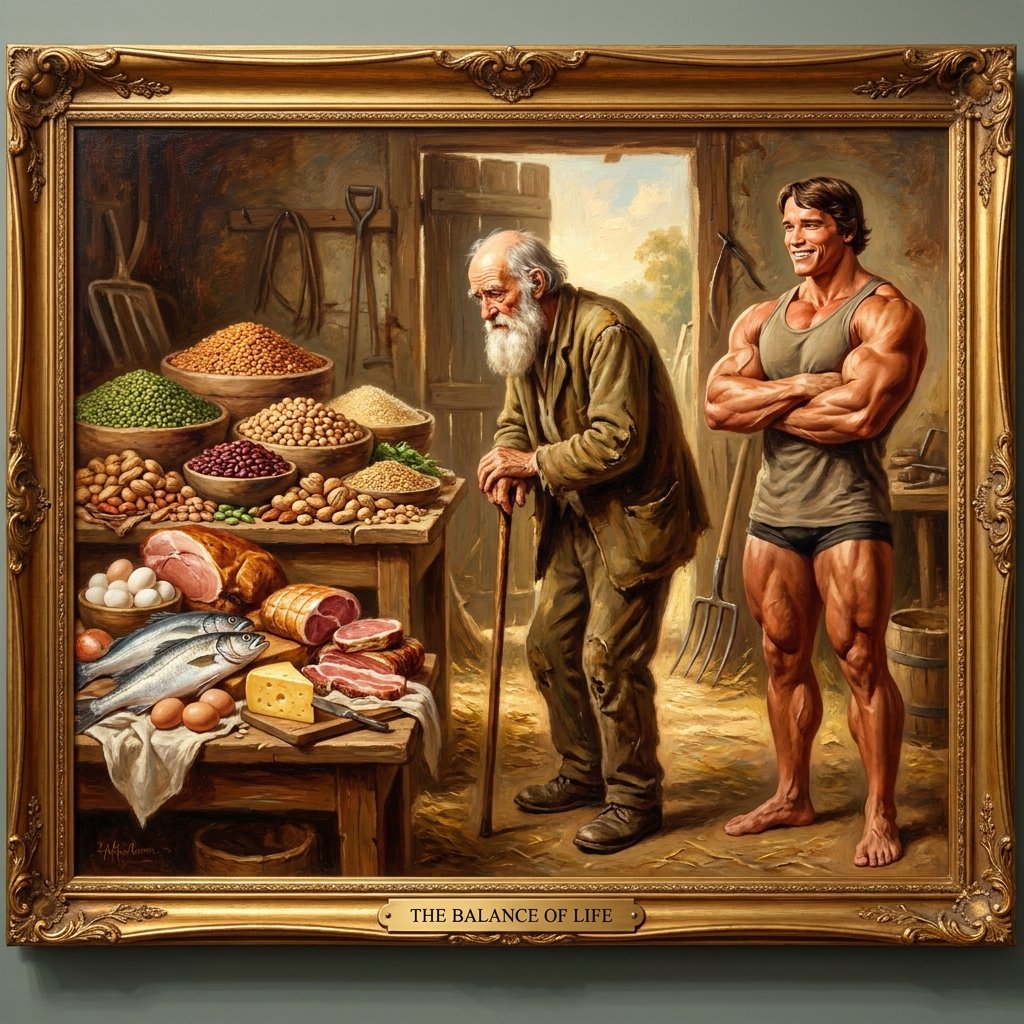
It’s the source of protein rather than the amount of protein.
Plant proteins are lower in methionine and cysteine and generally lower in branched-chain amino acids, and vegan diets measurably lower circulating methionine. This fact is supported by the epidemiology that we discussed earlier, plant based protein improves outcomes. The convergence of mechanistic literature from non-human models and epidemiologic literature from hundreds of thousands of humans in cohort studies ends up suggesting that amino acid composition is what’s important rather than quantity of protein.
After 65 inversion—is it real?
Does consuming more protein over age 65 protect against frailty? The evidence is mixed.
- Adults consuming 1.2 g/kg/day lost about 40% less skeletal muscle over three years than those at 0.8 g/kg/day, and higher protein intake is associated with lower frailty risk in observational data, including UK Biobank participants over 50.
- Yet a British twins analysis found higher protein intake associated with more sarcopenia.
- A low-protein Mediterranean pattern has been associated with greater muscle mass and strength.
- And plant, but not animal, protein has been associated with reduced frailty risk (in the Harvard Nurses study).
- In mice, protein restriction blunted the age-associated rise in frailty; started late in life, it lowered lean mass without worsening frailty.
- Human data suggest that exercise largely offsets the lean mass lost on a lower-protein diet.
Complications
Sex. In the study that produced one of the largest protein-restriction effects, male mice lived about 35% longer and female mice lived about 22% shorter. Most of the amino-acid restriction lifespan wins are in males. Essentially all of the popular advice on this subject, mine included, is extrapolated from male animals. This is confusing and troubling and undermines the certainty of recommendations by adding the extra dimension of gender.
Who this does not apply to. The review is explicit that pregnant women, growing children, people eating restricted calories, anyone recovering from injury or illness, and the substantial number of older adults who are already under-eating protein because of appetite, cost, or isolation do not apply. For these groups, restriction risks real harm. People in a catabolic state on GLP’s should also be included in this list. Heavy exercisers may need more protein, or at least tolerate more without metabolic cost.
Putting it together
Six lines of evidence now converge. The genetics and pharmacology establish that growth signaling is causally involved in aging. The biomarker data show IGF-1 tracking epithelial cancers along a U-shaped mortality curve. The rodent dietary experiments show that lowering protein reproducibly extends life, mediated substantially through FGF21 and mTORC1 rather than IGF-1. The amino acid decomposition shows the active ingredients are methionine, isoleucine, and valine. Not leucine, and not total protein as such. Short-term human trials show that protein and amino acid restriction improve metabolic surrogates within weeks. And human epidemiology shows that source is more important than amount, with plant protein favored and total protein, if anything, protective.
The reconciliation is that both literatures are describing composition. In the mice it is methionine, isoleucine, and valine. In the humans it is animal protein, red and processed meat, and the dietary pattern that travels with them. Those are largely the same finding wearing different clothes, because the foods richest in methionine and BCAAs are exactly the animal based foods that cohort studies have been flagging for thirty years. What neither literature supports is eating less total protein while leaving the amino acid profile unchanged. That costs you muscle and buys you very little.
What this implies in practice
- Change the composition before you change the quantity. Plant protein, minimal red and especially processed meat. This is the intervention with the most consistent mortality evidence behind it, and it is now the move with the most coherent mechanism behind it too. (There are other reasons to avoid beef, including bovine leukemia virus and the climate impact of the cattle industry).
- If you’re supplementing with plant protein powder, make sure you’re not overdosing on heavy metals.
- Keep total protein adequate rather than maximal: roughly 1.0–1.6 g/kg/day depending on activity. Understand that the top of the range is to support training. Nothing in the literature suggests that eating more protein than you need extends life.
- Treat the protein-fortification of everything with suspicion. It is a marketing phenomenon riding on an evidence base that does not exist.
- Train against resistance. This is the least ambiguous recommendation in the whole post. Exercise lets you spend the anabolic signal building useful tissue instead of leaving mTORC1 idling, and it appears to let you hold muscle at a lower protein intake.
- Be genuinely cautious with isolated BCAA and whey supplementation beyond what you need to build the muscle you want, particularly if you are already insulin-resistant. Isoleucine and valine now have direct experimental anti-lifespan data behind them.
- At all costs avoid anabolic and androgenic steroids.
- If you are pregnant, growing, ill, injured, frail, or already under-eating, none of the restriction argument applies to you. Protein deficit is the danger.
- After roughly 65–70, or if you are in a catbolic state, or if you are recovering from illness, or in anyone showing early sarcopenia, I would still err on the side of protein albeit with noticeably less confidence previously. In all cases, a stronger preference for plant sources and resistance training as the first line rather than protein volume.
So how certain are we, really?
- Near-certain. The nutrient-sensing axis is causally involved in aging. Knock out the growth hormone receptor and mice live 30–60% longer. Inhibit mTORC1 genetically or pharmacologically and lifespan extends in every model tested. Delete S6K1 and mice live longer. Humans with Laron syndrome are nearly free of cancer and diabetes despite being obese. This is pretty clear and it holds across a billion years of evolutionary distance.
- Strong. In laboratory rodents, lowering methionine, isoleucine, or valine extends lifespan and compresses frailty. This has been replicated across labs, strains, and species, with a coherent mechanism running through FGF21, GCN2, and mTORC1, and it is effective even when started in late life. My confidence here is high for male mice but lower for females, where the same intervention has shortened life.
- Moderate. Protein source matters more than protein amount for human mortality, and substituting plant for animal protein is the best-supported dietary change available. Hundreds of thousands of person-years support it and the mechanism now agrees with the epidemiology. It remains observational and vulnerable to confounding by overall diet quality since people who eat more plant protein differ in a hundred other ways.
- Moderate. Short-term protein or BCAA restriction improves human metabolic health. Randomized, replicated, mechanistically coherent, and consistent with the animal work. But weeks long, small, and measured entirely on surrogate markers.
- Weak. That any of this extends human life. There is no direct evidence whatsoever. The inference runs from mouse lifespan through human surrogate biomarkers and hopes the bridge holds.
- Weak. The age-dependent flip. That protein is harmful in midlife, protective after 65. One unreplicated cohort built on a single 24-hour dietary recall, now facing frailty data that point both ways.
- Weak. Any specific number. Nobody can tell you your optimal protein intake from evidence, and the precision offered by books and podcasts on this point is manufactured.
- Essentially unsupported. That eating more protein than you need extends life or slows aging. This is the claim that underlies a massive supplement industry. The high-protein recommendation for older adults is defensible as sarcopenia prevention but it has never been demonstrated as a longevity intervention, and the animal data run in the opposite direction.
Where that leaves me: protein is neither a poison nor a longevity drug. The best-supported claim in this entire literature is narrow and slightly boring: what your protein is made of matters more than how much of it you eat, and the amino acids that appear to matter most are concentrated in exactly the animal foods the epidemiology has been flagging for decades.